Finance teams now use ChatGPT less like a chatbot and more like a reasoning layer on top of spreadsheets, filings, research, and internal workflows. The value is real, but so are the risks: hallucinated citations, privacy exposure, weak audit trails, and over-trusting generated numbers.
Quick answer: ChatGPT is useful for finance when it drafts and checks work that a human can verify: Excel formulas, variance commentary, research summaries, credit memo outlines, accounting memos, board-pack narratives, and personal-finance education. It should not make investment decisions, file taxes, approve credit, or post to financial systems without expert review.
| Finance use case | Good fit? | Risk control |
|---|---|---|
| Excel formulas and scenario drafts | Strong | Keep calculations in Excel and verify formulas |
| Research summaries | Strong with sources | Require citations and check source documents |
| Accounting memo first drafts | Useful | CPA/controller reviews final position |
| Credit and underwriting support | Useful with connected data | Keep decisioning in governed systems |
| Personal finance education | Useful | Verify against IRS, custodian, or advisor |
| Trading signals or tax filing | Poor fit | Use qualified systems and professionals |
Source check — June 4, 2026: OpenAI says ChatGPT for Excel and Google Sheets are generally available across plans and that financial-data integrations include providers such as Moody’s, Dow Jones Factiva, MSCI, Third Bridge, MT Newswires, and FactSet. OpenAI’s live pricing page also separates Free, Go, Plus, Pro, Business, and Enterprise plans, with Business and Enterprise emphasizing no training on business data.
If you are comparing finance copilots, read this next to Claude AI for finance, AI accounting and finance tools, and ChatGPT for Excel and Sheets.
Is ChatGPT Accurate Enough for Financial Analysis?
ChatGPT is accurate enough to accelerate finance work, but not accurate enough to run finance work unsupervised.
The key change in 2026 is that more workflows are grounded in deterministic sources: Excel cells, uploaded workbooks, financial-data apps, MCP connectors, filings, transcripts, and internal knowledge bases. That improves quality because ChatGPT is less dependent on memory and more dependent on source material.
Benchmark rankings also move fast. Older finance AI pages often cite Finance Agent v1.1 numbers. By June 3, 2026, Vals AI’s public leaderboard had moved to Finance Agent v2, with Gemini 3.5 Flash, Claude Opus 4.8, and GPT-5.5 close together near the top. The point is not that one model permanently wins. The point is that all frontier models still need verification on realistic analyst work.
Use ChatGPT for:
- formula drafting and explanation;
- variance commentary;
- research synthesis with cited sources;
- first drafts of credit, accounting, and board memos;
- Python or SQL helpers for non-production analysis;
- personal finance education and scenario framing.
Do not use it as the final source of truth for:
- numbers copied into a filing, model, credit decision, or client deck;
- tax rules without checking official guidance;
- investment advice;
- trade execution;
- SOX-controlled evidence or audit documentation without a governed wrapper.
Comparing ChatGPT vs Traditional Finance Software in 2026
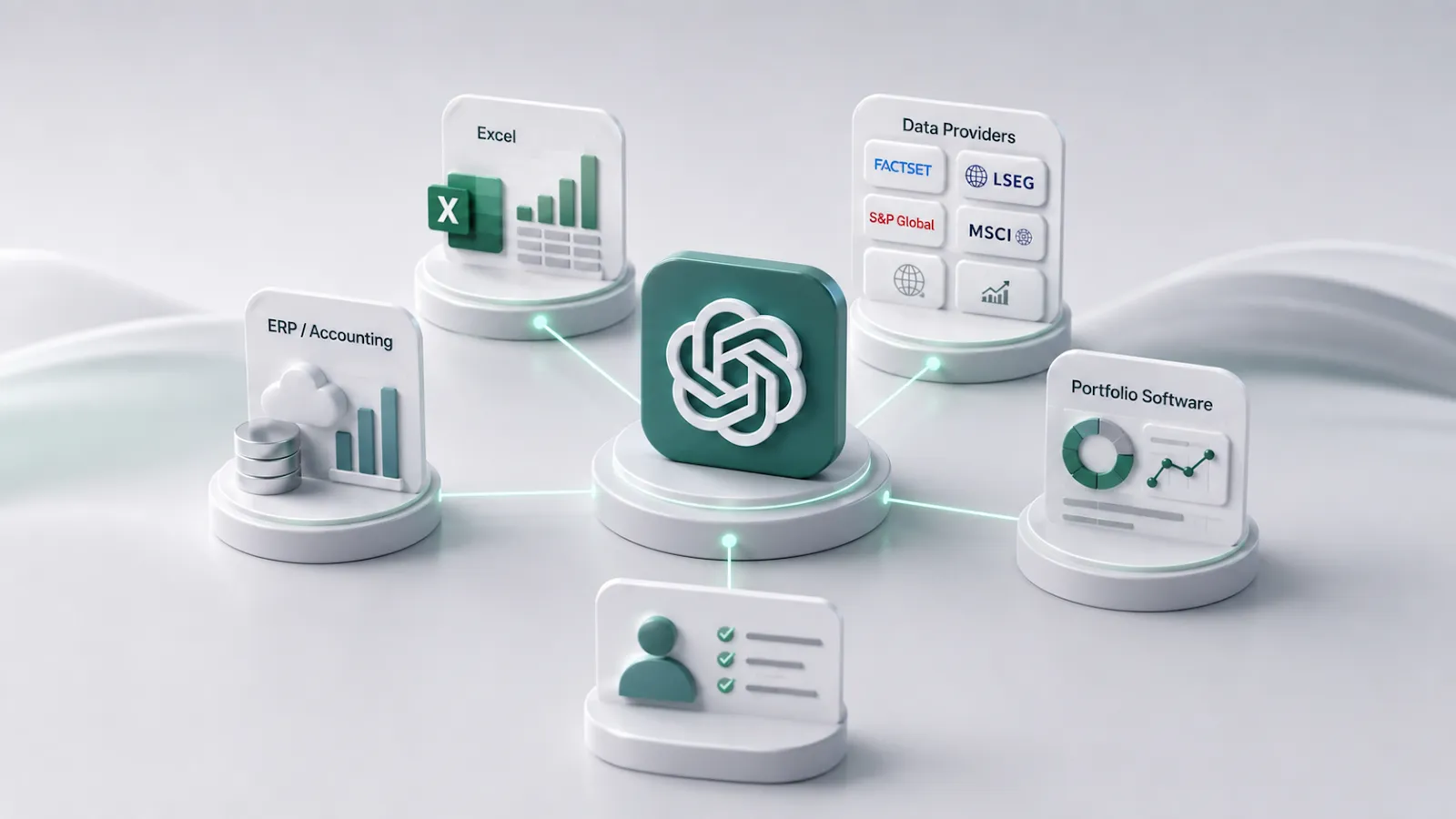
There is no true traditional equivalent to ChatGPT in finance software. Bloomberg, FactSet, Excel, and ERP systems all function as systems of record or structured analytics tools.
ChatGPT sits one layer above them as a reasoning interface that interprets, rewrites, and synthesises outputs across these systems, rather than replacing any of them.
- Excel is where the overlap got real this year. OpenAI launched ChatGPT for Excel (powered by GPT-5.5) on March 5, 2026, with general availability on May 5. The add-in writes formulas, traces dependency errors, and runs scenarios in plain English. Excel still does the math; ChatGPT writes the formula you would have typed.
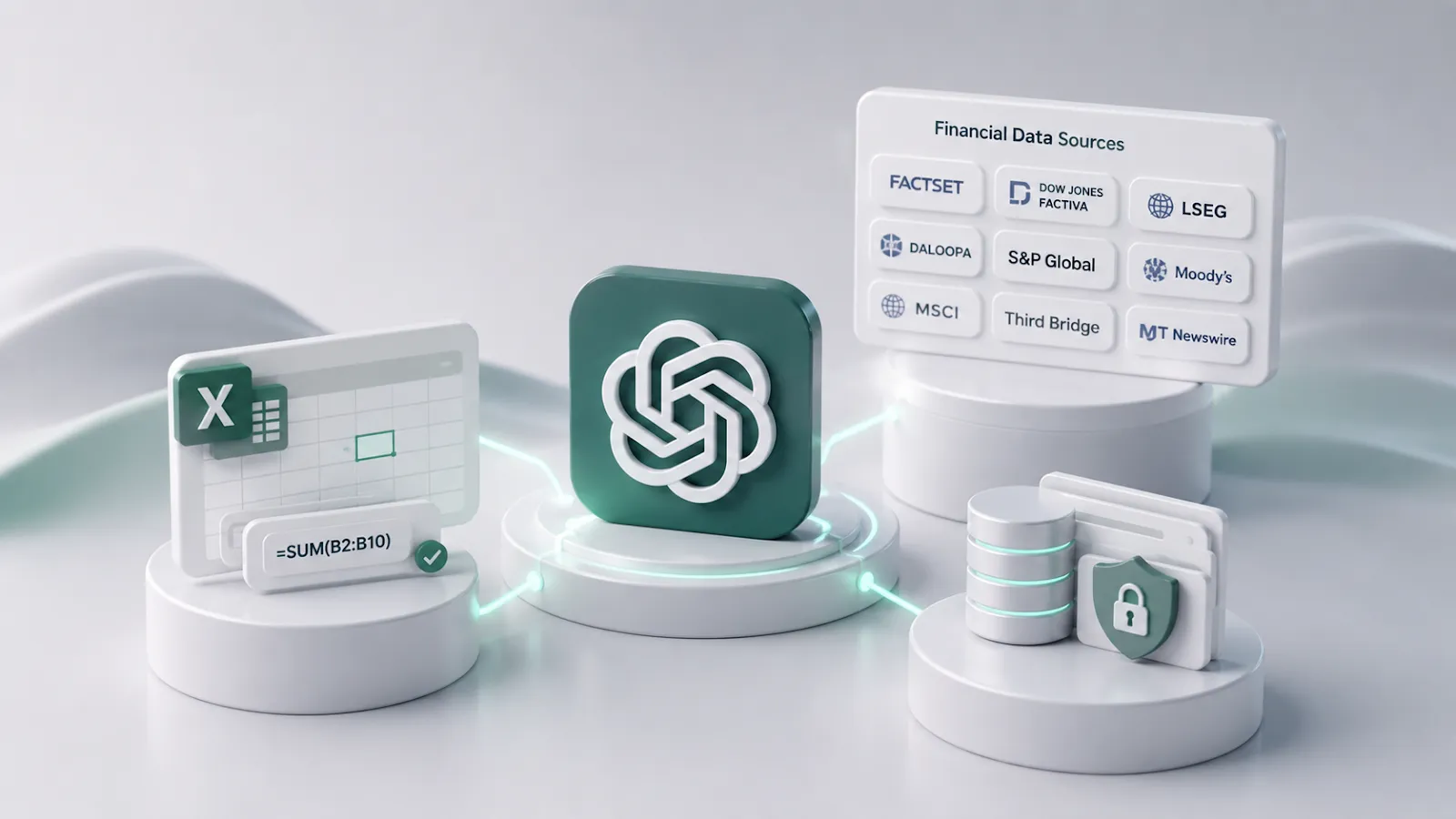
- FactSet, LSEG. ChatGPT does not replace these for live market data; it now talks to them. OpenAI’s March 2026 announcement named FactSet, Dow Jones Factiva, LSEG, Daloopa, S&P Global, Moody’s, MSCI, Third Bridge, and MT Newswire as financial-data app integrations. ChatGPT becomes a thin reasoning layer on top of the data feed.
- ERP and accounting software. ChatGPT works with your ERP as a read-layer analyst, not a system operator. Export a trial balance, P&L, or GL extract, paste it in, and ChatGPT can flag anomalies, draft variance commentary, or build a narrative for management reporting — in minutes rather than hours. MCP connectors (NetSuite, Coupler.io) now enable live read queries without manual exports, though regulated firms should keep these strictly read-only and build their own audit wrapper, since ChatGPT produces no SOX-compliant log.
- Dedicated portfolio software. ChatGPT sits alongside your portfolio system as a communication and interpretation layer. Feed it a performance report or holdings export and it will translate allocation data, fee structures, and risk metrics into plain-language client summaries — a task practitioners consistently rate among its strongest finance use cases. Via MCP connectors like Truthifi, it can now query live holdings across 18,000+ institutions without a manual upload.
Treat ChatGPT as a junior analyst with no compliance training, infinite typing speed, and a tendency to invent footnotes when it isn’t sure. It sits on top of your stack.
That framing explains both the value and the limits of ChatGPT for financial analysis in regulated environments.
ChatGPT Advantages and Limitations for Finance
Major advantages include the following:
- Speed
- Low cost per output
- Plain-English flexibility
- The ability to scale work that previously required billable analyst or contractor hours
These show up most clearly in tasks where the output is prose, code, or synthesis rather than a specific dollar figure.
The limitations:
- Numbers and citations are the highest-risk failure mode.
- Audit trail is missing by default. A ChatGPT conversation is not controlled evidence.
- Context collapse on long documents. Hallucination rates climb sharply as document length increases.
- Data privacy depends on the plan. Free, Plus, and Pro train on user content by default with opt-out available; Business and Enterprise do not train on workspace inputs. For client-confidential data, that distinction is the line.
How to Use ChatGPT Efficiently and Avoid Common Mistakes
Six setup decisions separate finance professionals who get value from ChatGPT from those who get burned.
- Bring data into the prompt. Paste the 10-K excerpt or pull from a connected app. If you ask “what is X’s gross margin” without giving ChatGPT the source, it will often invent a confident-sounding number.
- Prompt for structure. Specify baseline data, time horizon, constraints, and request a sensitivity analysis or list of assumptions.
- Use thinking mode for analysis, instant for summarization. Reasoning models trade speed for fewer leaps; for DCF assumptions or risk framing, the slower model earns its time.
- Verify every number against source. Verification is spot-checking, not redoing the work. Trace the figures that will appear in your deliverable back to the source document. Sanity-check the math (a gross margin showing as 1.8% instead of 18% is the kind of error that surfaces in seconds). And confirm any cited rule, bracket, or standard against the original publication.
- Do not paste client-confidential data into Free or Plus. Use Business or Enterprise. If your firm has not approved either, treat ChatGPT as a public surface.
- Iterate. Break complex tasks into a sequence of smaller prompts, get each step right before stacking the next one, and treat the conversation as a working draft rather than a one-shot output.
How Do Financial Experts Use ChatGPT for Their Work?
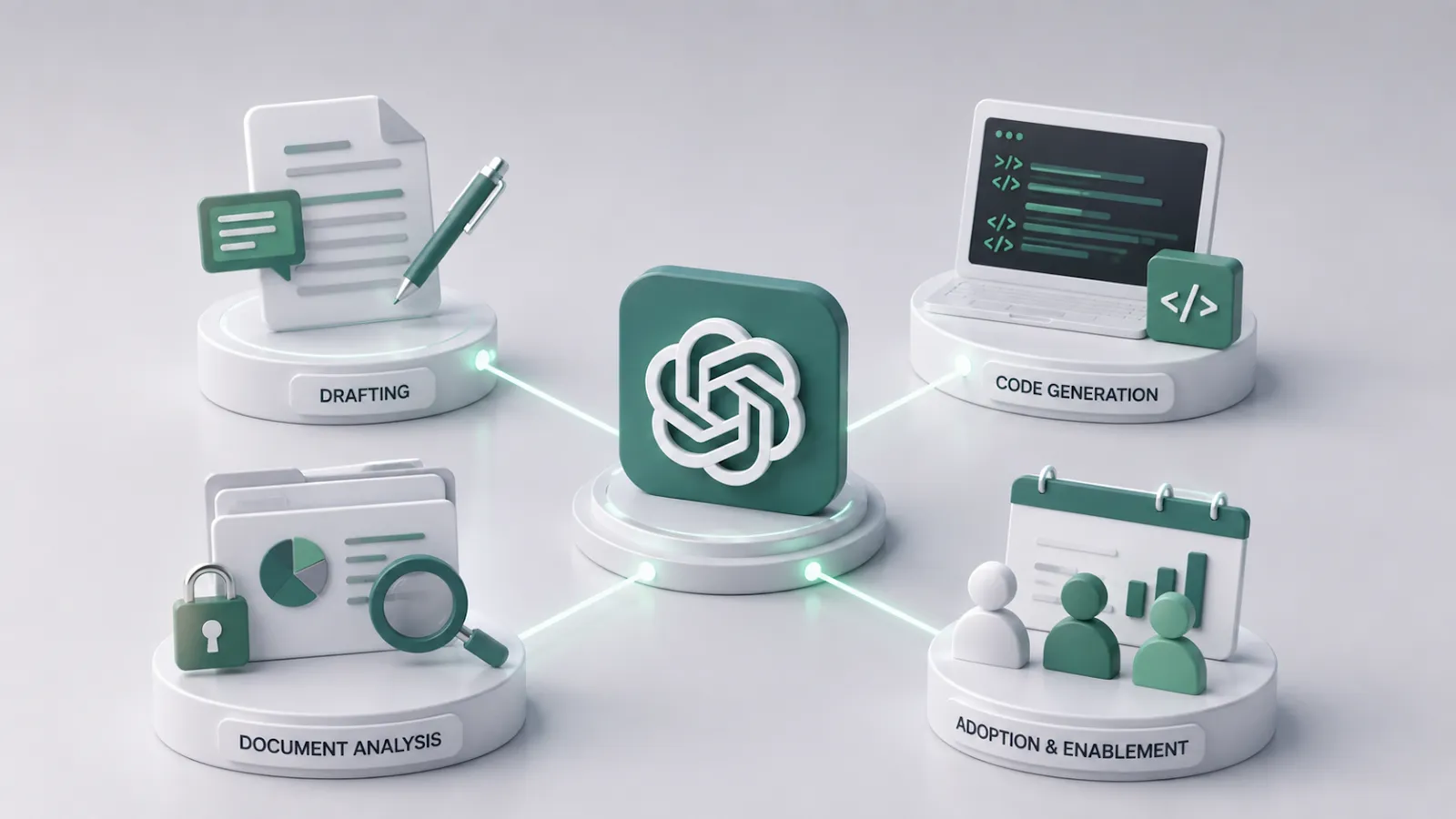
Across the practitioners writing publicly in 2025 and 2026, the most common workflows fall into three buckets: drafting, code, and document analysis. The specifics show up in named cases.
Drafting. Glenn Hopper, head of AI research and development at Eventus Advisory Group in Memphis, built a retrieval-augmented bot trained on the firm’s library of prior memos. It now drafts technical memos for goodwill impairment, going-concern, and complex revenue recognition. Hopper estimates the bot took an accounting memo from a four-hour task to a 30-minute task that includes careful human review. The implementation took about 60 hours of his own time and required deep AI expertise.
Code generation. Don Tomoff, CPA, director at Invenio Advisors in Cleveland, has stopped outsourcing coding work since January 2023. He recently asked ChatGPT for VBA code to find a particular text string and delete every row above it in an Excel spreadsheet. The bot returned working code; Tomoff iterated on edge cases until it shipped. Outsourcing the same job previously cost him “$150 per hour, or up to $2,000 for a typical project.”
Document analysis under confidentiality. Baridhi Malakar, PhD, Senior Model Risk Analyst at Western Alliance Bank, built a privately-hosted “Private GPT” running open-source models locally on his own machine via Ollama, with retrieval-augmented generation over investment documents. The driver was confidentiality: “For professionals working in buy-side investment research, the use of ChatGPT and similar tools raises a major concern: confidentiality. Uploading research reports, investment memos, or draft offering documents to a cloud-based AI tool is usually not an option.”
Adoption. None of these workflows materializes without leadership push. Cameron Kinloch, former CFO at Weights & Biases, told CFO Brew she gamified adoption on her finance team: monthly meeting demos of ChatGPT use cases, with gift cards for the top three. Even at an AI-native company, “no one’s actually taking the time to embed it in their workflows…there needed to be a bit more top-down push.” Two patterns held: junior staff adopted faster than seniors, and dedicated time on the calendar was the unlock.
Most Effective ChatGPT Applications in Work With Finance
Here are more examples of what ChatGPT can realistically do, where its limits show up, and what you still need to verify yourself.
Stock Market Analysis and Predictions
ChatGPT synthesizes sentiment from earnings transcripts, news, and analyst notes faster than any human. With financial-data apps live, that synthesis can pull from licensed feeds rather than the open web.
ChatGPT has no edge on price prediction, though. Models tend to over-extrapolate recent returns and read more optimistic than realized data warrants. Use it to structure your view, not to pick the trade.
Portfolio Optimization Strategies
ChatGPT scaffolds a strategy well: identify a stock universe, frame the diversification logic, and write the rebalancing rules. The math should run in dedicated software. ChatGPT does not see your tax basis, your concentration limits, or this morning’s correlations.
Financial Modeling and Forecasting
The 2026 capability jump shows up most clearly here. OpenAI’s internal investment-banking benchmark for three-statement models with proper formatting and citations went from 43.7% on GPT-5 to 87.3% on GPT-5.4 Thinking.
That is a vendor-internal number, but the direction is consistent with what practitioners report: GPT-5-class models with the Excel add-in produce coherent first-draft DCFs, sensitivity tables, and scenario forecasts that previously took analyst hours.
The judgment layer (which assumptions hold, where the model breaks, what management is hiding) is still yours.
Risk Assessment Calculations
ChatGPT writes useful risk-framework prose: identifies catalysts, structures stress tests, and drafts the narrative around a Monte Carlo output.
For the simulation itself, dedicated software does the math better. Set up the inputs and explain the outputs with ChatGPT; do not let it run the simulation as if it were the simulator.
Credit Analysis and Scoring
One of the most important 2026 case studies comes from Better.com. They plugged its Tinman underwriting platform into ChatGPT Enterprise via a custom MCP connector on March 5, 2026, making it the first conversational credit decision engine inside the product.
Loan officers can now underwrite mortgages and home equity loans against guidelines from more than 45 institutional investors, including Fannie Mae, Freddie Mac, Federal Housing Administration, JPMorgan Chase, Truist, and U.S. Bank. Better.com claims approvals can happen in as little as 47 seconds, with a median time of 2 minutes and 24 seconds, versus an industry average closer to 21 days.
Critics pushed back quickly. Colin Robertson told Inman that the focus on 47-second approvals felt more like a publicity move because the full mortgage process still takes 30 to 45 days. Both perspectives matter. ChatGPT has clearly entered the credit underwriting workflow, but the same regulatory requirements still apply, including SR 11-7 model governance, OCC AI guidance, and ECOA disparate-impact monitoring.
Valuation Model Explanations
ChatGPT shines at structure, narrative, and speed: turning assumptions into modeled outcomes, turning numbers into logic.
It struggles with which exit-multiple methodology fits, which comparable trades are noise, or how to weight a control premium. Use it to explain a DCF; do not let it pick the assumptions.
Merger and Acquisition Insights
For outside-in target review, summaries of 10-Ks and 10-Qs, and first-pass diligence question drafts, ChatGPT compresses the timeline.
EY’s published view on M&A diligence converges on the same caveat as other Big 4 firms: VDR data residency, hallucinated specifics, and the unwritten practice of tax authorities are invisible to the model. Use it to prepare for the diligence call, not as a substitute for one.
Cash Flow Projection Tools
ChatGPT writes a clean rolling 13-week cash forecast template against historical data you provide.
It will not anticipate a new competitor, a supply-chain disruption, or how a Black Friday campaign reshapes Q4 receipts. ChatGPT structures the template; you bring the judgment.
ESG Investment Screening
ChatGPT can frame a screen against ESG criteria and explain the logic of low-volatility or sector-neutral overlays. Without integrations to a licensed ESG feed (MSCI, Sustainalytics, S&P Global), the screen is opinion, not data.
Crypto Market Trend Analysis
Useful for sentiment synthesis, narrative identification, and basic Pine Script generation. Not useful as a price oracle. Any forecasts ChatGPT produces are hypothetical scenarios; verify against on-chain data or your venue’s API before acting.
Options Trading Strategy Builder
ChatGPT scaffolds covered-call, vertical-spread, and iron-condor frameworks; explains the Greeks; drafts entry and exit checklists.
It does not see live Greeks against your broker’s chain or place orders. Out-of-sample backtest anything before risking capital.
For finance professionals who want to build prompt design as a structured skill rather than picking it up ad hoc, Coursiv’s AI Mastery pathway covers ChatGPT, Claude, Gemini, and Perplexity in bite-sized lessons (about 10 minutes each), with finance-relevant modules on prompt engineering, custom GPTs, and project-based workflows. The format suits the reader who wants to build AI fluency without leaving their day job.
Can You Integrate ChatGPT With Finance Tools to Improve Accuracy and Quality of Your Work?
Yes, for specific workflows. The integrations launched in 2026 close the accuracy gap by replacing ChatGPT’s training-data guesses with deterministic source data, but only where a connected app, MCP connector, or Excel cell sits between the prompt and the answer.
Three real examples:
- ChatGPT for Excel and Google Sheets. Calculations run in Excel; ChatGPT writes and explains formulas, links answers to specific cells, and asks for permission before making changes.
- Financial-data app integrations. FactSet, Dow Jones Factiva, LSEG, Daloopa, S&P Global, Moody’s, MSCI, Third Bridge, and MT Newswire are live or rolling out as ChatGPT apps via OpenAI’s Model Context Protocol.
- Custom MCP connectors against firm data. Better.com’s Tinman connector is the published example of a regulated lender exposing its underwriting engine inside ChatGPT Enterprise. The architecture (ChatGPT as conversational front end, the firm’s deterministic engine as decisioning layer) is replicable for credit, claims, fraud screening, and similar workflows.
How Is ChatGPT Used by Accounting Professionals?
The AICPA-adjacent community has converged on a consistent posture: ChatGPT helps with drafting, code, summarization, and explanation, layered with specific governance controls.
The use cases that matter most:
- Memo drafting and report automation.
- Tax research and policy Q&A. Custom GPTs over a firm’s SOP library answer “how do we handle [scenario]” with reference to the firm’s own historical positions.
- Code generation for Excel, VBA, and Python.
- Document summarization. 10-Ks, 10-Qs, earnings transcripts, board minutes, audit work papers. Financial-data app integrations make this dramatically more reliable than open-web summarization.
The capability is the easy part. The governance is where most firms get stuck:
- SOC 1 and SOC 2 reports are demanded of any vendor in financial reporting workflows.
- Strict prohibition on PII or unpublished financials in Free or Plus.
- Custom-GPT instructions that direct the model to refuse when it lacks source documents.
- Verification checklists tie every figure to a source.
How Can You Use ChatGPT for Personal Finance Management?
For your own ChatGPT financial planning, treat the tool as a tutor and a brainstorming partner. Leave the fiduciary work to a human.
Use it for:
- Concept explanation. Tax-loss harvesting, RMDs, Roth conversion sequencing, sequence-of-returns risk in retirement, and estate-tax basics.
- Scenario modeling. Retirement projection under three return assumptions; mortgage refinance break-even calculations; Roth-vs-traditional contribution decisions.
- Insurance and coverage review. Identify common coverage gaps before a renewal call to have a smarter conversation with your agent.
- Pre-meeting prep. Model your situation and prepare specific questions for your CFP or CPA. You walk in with a structured agenda instead of a vague concern.
Do not use it for tax filing, trade execution, security selection inside your IRA, or any irreversible decision you would make based on its output alone. Verify dollar figures, tax-bracket numbers, and any cited rule against the IRS or your custodian.
Best ChatGPT Prompts for Personal Finance in 2026
The strongest prompts share three traits: they specify the data, the constraint, and the desired output format.
For ChatGPT for personal finance budgeting, the framing of the prompt drives the quality of the output. “Help me budget” returns generic advice. “Given a household after-tax income of $X and these recurring obligations [paste], propose three budget allocations: aggressive savings, moderate, and lifestyle-prioritizing. For each, model 12-month savings and three risks” returns something you can act on.
The ChatGPT financial advisor prompts below cover the four most common personal finance questions.
Retirement scenario modeling.
If I delay Social Security from 62 to 70, model the break-even age and the cumulative income difference under three life-expectancy scenarios (85, 90, 95).
Verify the numbers before acting.
Tax-concept explainers.
Explain tax-loss harvesting in plain English. Then list the wash-sale rules that apply to me as a retail investor in [state]. Cite the IRS publication for each.
The citation request flushes out fabricated rules.
Debt-strategy framing.
Compare the avalanche and snowball methods for paying off my listed debts [paste]. Project payoff timelines for each. Recommend one based on my listed risk tolerance, and explain the trade-off.
Insurance-coverage gap analysis.
Given my listed insurance policies and household size, identify the three most common coverage gaps. For each, name the typical policy that fills it and what to ask my agent.
ChatGPT Plus vs Free for Finance Work
The free tier handles concept exploration and personal study well enough. The paid tiers earn their place when client data, modeling, or volume comes into play.
| Plan | Price | What you get | Best for finance work |
|---|---|---|---|
| Free | $0 | Limited access to GPT-5.5 Instant. Limited messages, image generation, and basic file uploads. Ads now appear at the bottom of responses in the US (since February 2026). Workspace content used to train OpenAI models by default, with opt-out available. | Personal AI literacy, studying for a CFA module, exploring concepts. Not appropriate for any client data. |
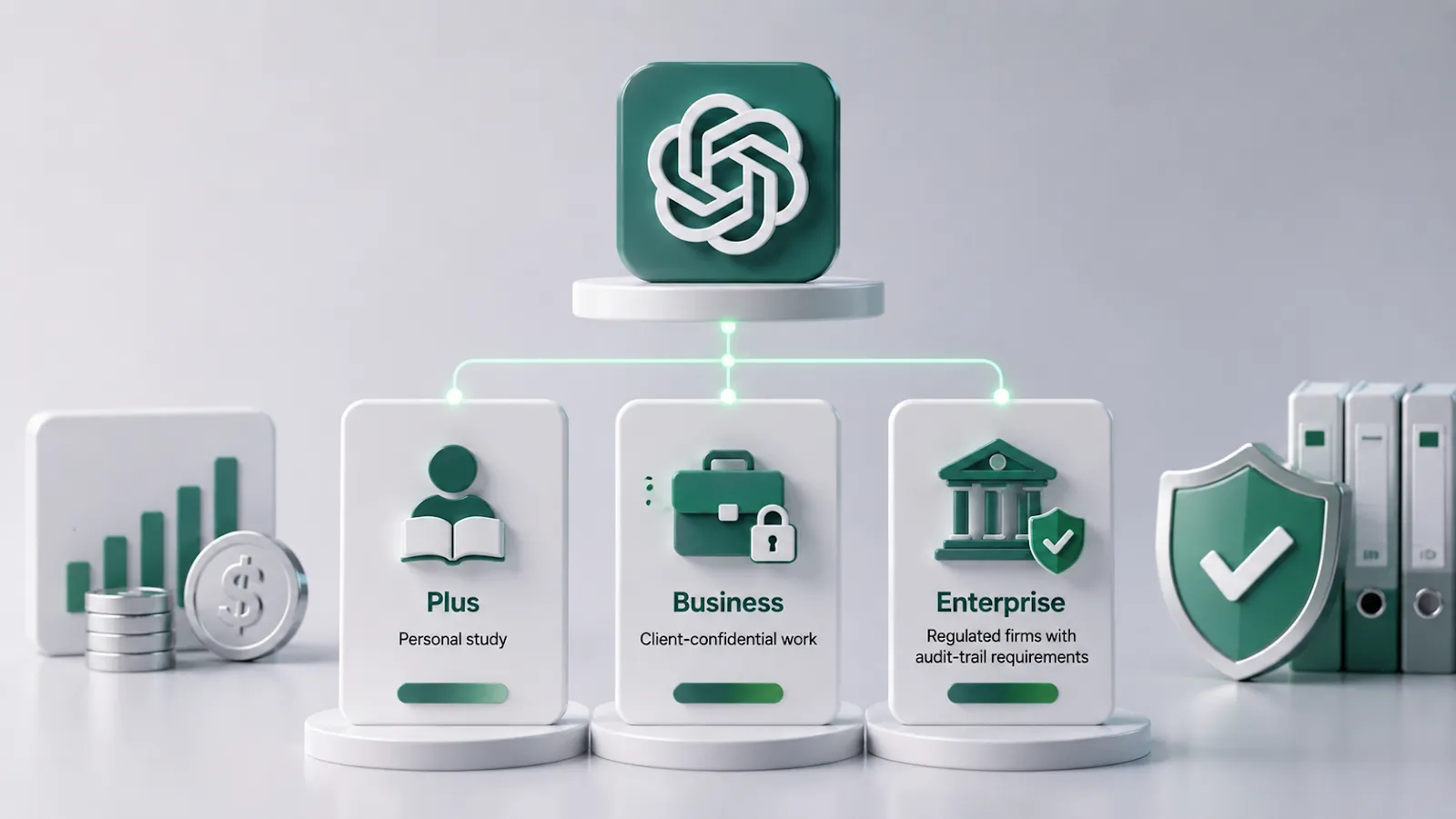
| Plus | $20/month | GPT-5.5 Instant with higher message limits, generous access to GPT-5.5 Thinking, custom GPTs, deep research (capped at 10 runs/month), agent mode, and Advanced Data Analysis (the Python sandbox previously called Code Interpreter, which runs deterministic math on uploaded data instead of guessing from training). | Personal study, non-confidential research, building first custom GPTs, light modeling work. The practical floor for individual finance professionals. |
| Pro $100 | $100/month | GPT-5.5 with 5x Plus usage limits. | Analysts hitting Plus message caps regularly but not yet in need of the full Pro tier. |
| Pro $200 | $200/month | GPT-5.5 with 20x Plus usage limits. Unlimited reasoning mode. | Heavy deep-research workloads, multi-hour modeling sessions, full-time analyst use. |
| Business | $30/user/month (monthly) or $25/user/month (annually) | Workspace content is not used to train OpenAI models. Admin controls, shared custom GPTs across the workspace. | Client-confidential work. The minimum tier for any deliverable touching client data. |
| Enterprise | Custom pricing | Workspace content not used for training. SSO, role-based access, audit logs, data residency controls. | Regulated firms (banks, asset managers, CPA firms) with audit-trail requirements. |
Decision tree: Plus for personal study; Business for client-confidential work; Enterprise for regulated firms with audit-trail requirements.
Before paying for a personal plan, check with your firm’s IT or compliance team. Many large finance employers already have a ChatGPT Enterprise contract, and using your firm credentials is safer than your personal Plus account for anything work-related.